




What do you do when your emotions get the better of you? Do you call your bestie, listen to your favorite album, or go for a run? How about a good couch nap?
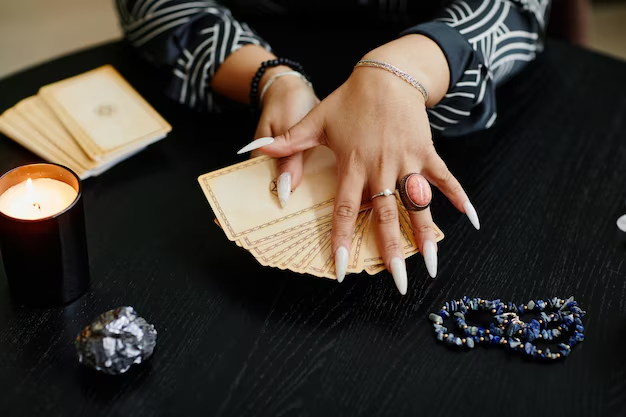
I do all the above, but once I’ve calmed my feelings you’ll likely catch me shuffling a deck of cards. Tarot, to be exact. For me, tarot isn’t just a powerful way to connect with my intuition and the energies around me, but it’s also a tool for radical self-care and awareness that helps me navigate life’s ups and downs.
What is radical self-care and awareness?
When I mention self-care, I mean more than the marketing buzzword. We’re talking about the kind of radical care that has been historically elusive for many Black women. It is essential in a society that lowkey and overtly tells us we don’t deserve mental, physical, and spiritual nurturing. In this way, as Audre Lorde and bell hooks taught us, caring for your whole self isn’t only necessary, it’s resistance.
We all love a good Sunday reset, but radical care goes beyond pampering. It’s about self-love, setting boundaries, reclaiming rest, and honoring our full selves in a world that often does not. It’s about taking time to nourish every part of ourselves despite internal and external pressures that tell us the opposite.
The work of caring for our whole selves–mind, body, and spirit–involves a type of awareness and presence we rarely give ourselves these days. It’s the kind of awareness that leads to a better understanding of self without judgments or criticisms, fostering compassion, acceptance, and healing.
Why tarot?
I picked up tarot as a quirky preteen, but it fell by the wayside along with my B2K and Lil’ Bow Wow posters. That was until life put me through it in my twenties. Like many others, I rediscovered tarot during a dark personal period.
I had just left a toxic job and an on-again-off-again relationship to match its energy—all while my anxiety worsened and I became increasingly isolated. Searching for answers and intuitive care outside my therapy sessions, I asked my friend to pull out her tarot cards and read my energy.
Soon after, I knew I needed to get back into my practice, but this time in a more intentional and spiritually aligned way.
I reintroduced myself to tarot through an easy ritual, and you can too. I started every day by meditating, cleansing my energy, and then asking my guides, ancestors, or higher-self (whichever my spirit led me to) what the energy around my day was. Sometimes, I would ask for advice or simply a message I needed to carry with me.
Then, I would pull a single card, reflect on the message, and journal my thoughts and feelings. I consulted the guidebook or a favorite website if I needed clarity about a card’s meaning. For example, pulling The Fool card upright could point to a major new beginning, taking a leap of faith, or innocence, while drawing it reversed generally signals the shadow energy like lack of faith or recklessness. On the other hand, if you pulled The World card you might be experiencing a joyful ending (think graduation or relocation) or a sense of stagnation if it’s reversed.
Regardless of the guides, I always trusted myself first. For me, this was the key to strengthening and, most importantly, trusting my intuition first and foremost.
While people often think of tarot as a way to peep into the energy of the future, it’s also a powerful tool for self-care and shadow work. I’ve used it to examine emotional triggers, investigate how past traumas are presently affecting me, and see what ways I can care for my mind, body, and soul at a given time.
You can even use tarot to get clarity on how you might be internalizing oppression (for example, imposter syndrome or survivor’s guilt) and how you can move towards liberation personally and communally.
Tarot prompts introspection by encouraging us to slow down, reflect, and connect. Each card pull also allows us to pause and discover what we truly need at the moment. And, if you incorporate tarot into a daily ritual, the practice will help deepen your awareness and spiritual life over time.


How to use tarot for radical self-care?
You can find a reader you resonate with if you’re interested in using tarot for personal growth or radical self-care. Use your best judgment when seeking a healer and if something doesn’t feel right, then always trust that feeling. You can also ask your guides to lead you to the right reader.
Whether you decide to have a professional reading or not, I recommend building your relationship with the cards by getting a deck. Don’t be intimidated when you’re starting. Like most things, learning tarot takes time and intentional practice. Make space for your learning and keep a journal to track the messages, meanings, and symbols of the cards.
Most importantly, trust your inner knowing while reading. Yes, each card has its unique meanings and associations with astrology, numerology, and symbolism, but each card pull will also heavily depend on the energy of the specific reading.
The more time I devoted to my tarot practice, the stronger my connection to divination (and myself) got, and that will happen for you, too. And, on the bright side, you’ll be engaging in self-exploration in the process. Asking your deck simple yet intimate questions like: “How can I better care for myself at this moment?”, “What parts of myself am I neglecting?”, and “What shadow work do I need right now?” can be profoundly enlightening.
Devoting myself to practice and ritual not only reconnected me to tarot, but also to myself at a time when I felt stuck, exhausted, and alone. Although spiritual practice is not a replacement for mental healthcare, I found the combination of spiritual and mental wellness deeply transformative. I could see my therapist once a week while doing a daily ritual that increased my emotional awareness and sense of personal power. Committing to this self-care practice allowed me to reclaim my energy and cultivate a deeper relationship with myself and the (seen and unseen) world around me.
Instead of avoiding my uncomfortable emotions and triggers, tarot helped me navigate and ultimately transmute those feelings. Most importantly, my practice brought awareness to and helped me accept even the unpleasant aspects of myself. So when you think about tarot, I hope you’re able to benefit from the spiritual elevation and radical self-preservation it offers. Here’s your sign to pick up a deck and start on your journey.
